
Brushless DC Micro Diaphragm Pumps: Benefits and OEM Applications
Brushless DC Micro Diaphragm Pumps: Benefits and OEM Applications
Brushless DC micro diaphragm pumps combine the positive-displacement pumping principle of a diaphragm pump with the electronic control of a brushless DC motor. This combination makes them suitable for compact OEM equipment that requires controlled liquid transfer, air supply or vacuum generation.
Compared with traditional brushed DC motors, brushless motors do not use mechanical brushes for commutation. This removes one source of mechanical wear and can be beneficial in equipment designed for extended operation. However, the service life and performance of a complete diaphragm pump still depend on its diaphragm, valves, bearings, motor drive and operating conditions.
For equipment manufacturers, selecting a suitable pump involves more than choosing a brushless motor. The pump configuration, required flow rate, pressure or vacuum level, fluid compatibility, electrical interface and installation space must all be considered.
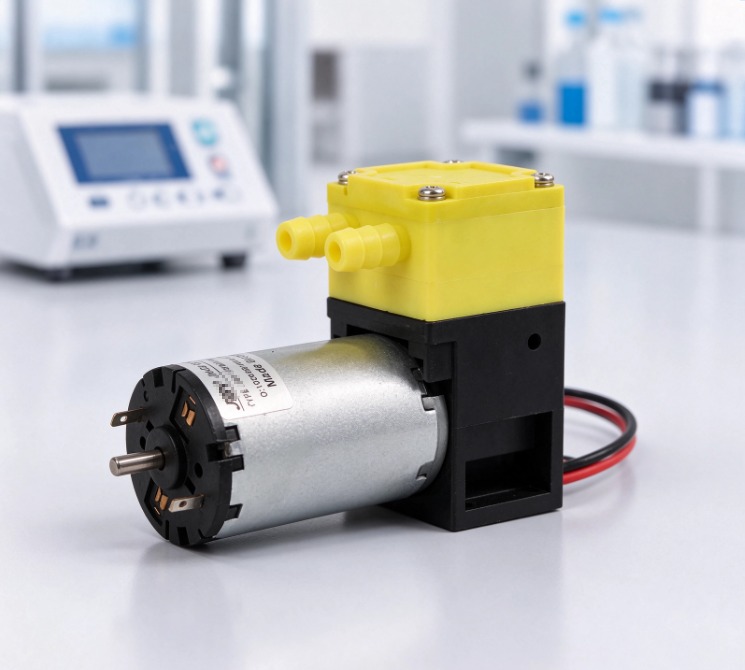
1. What Is a Brushless DC Micro Diaphragm Pump?
A brushless DC micro diaphragm pump is a compact positive-displacement pump driven by a brushless DC motor. The motor powers a mechanical drive mechanism that moves a flexible diaphragm back and forth, changing the volume inside the pump chamber.
As the diaphragm moves, the chamber alternately expands and contracts. Inlet and outlet valves control the direction of fluid movement, allowing the pump to draw in and discharge liquid or gas.
The basic diaphragm pumping principle is similar in liquid and gas applications, but the pump configuration, materials, valve design and other details may differ depending on the medium and operating requirements.
How a Brushless DC Motor Works
A brushless DC motor uses electronic commutation instead of mechanical brushes and a commutator. The motor controller switches current through the windings in a controlled sequence to produce rotation.
Because there are no mechanical brushes making contact during normal commutation, brush-related wear is eliminated. This can reduce one maintenance concern in equipment that operates frequently or for extended periods.
However, a brushless motor still requires a suitable electronic drive. The control method, wiring, feedback arrangement and speed-control capability depend on the motor and controller design.
For a technical introduction, see Microchip’s overview of brushless DC motor commutation.
How a Diaphragm Pump Works
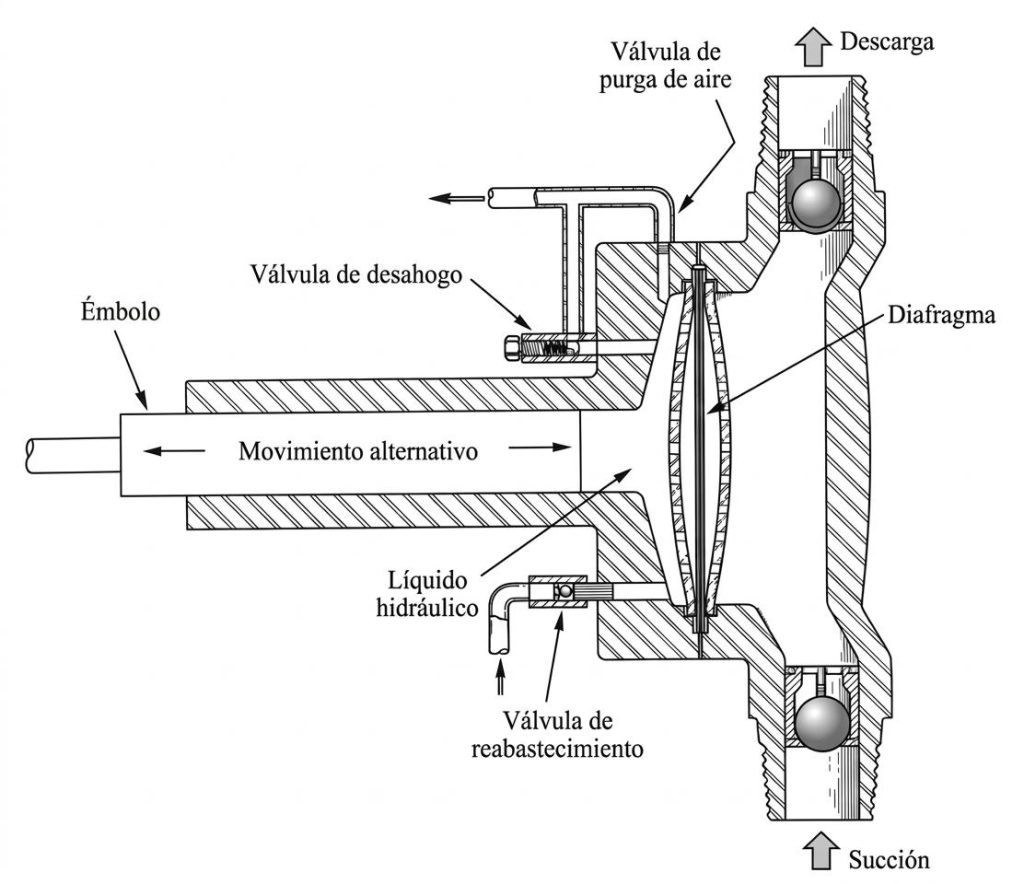
The diaphragm is the main pumping element. When it moves away from the pump chamber, the chamber volume increases and the pressure decreases. The inlet valve opens to allow the medium to enter.
When the diaphragm moves in the opposite direction, the chamber volume decreases. The inlet valve closes, and the outlet valve opens to discharge the medium.
This repeated cycle creates fluid flow. The same general principle can be used for liquid pumping and gas pumping, although the detailed design must be matched to the intended application.
2. Key Benefits of Brushless DC Micro Diaphragm Pumps
Brushless DC micro diaphragm pumps can offer several advantages for OEM equipment. The actual benefits depend on the pump model, motor design, controller and operating conditions.
No Mechanical Brush Wear
A brushless DC motor does not use mechanical brushes for commutation. This removes brush wear as a maintenance factor and avoids the need to replace motor brushes.
For equipment manufacturers, this can be useful when designing compact systems where maintenance access is limited or where frequent servicing is undesirable.
It is important to distinguish motor brush wear from overall pump wear. The diaphragm, valves, bearings and other components remain subject to wear and must be evaluated according to the operating conditions.
Suitable for Extended Equipment Operation
Brushless motors can be considered for equipment that operates frequently or for extended periods, provided that the motor, controller and pump are correctly selected.
Operating temperature, duty cycle, voltage stability, fluid properties and mechanical loading all affect the service life of the complete pump assembly.
A brushless motor alone does not guarantee a specific service life. OEM testing under representative operating conditions is still recommended.
Electronic Speed Control Options
Brushless DC motors are controlled electronically, which can provide options for adjusting motor speed.
Depending on the motor and drive configuration, speed may be controlled through an external signal, a dedicated controller or another specified interface. Not every pump model supports external speed adjustment.
If variable flow is required, equipment designers should confirm the available control method, operating range and relationship between motor speed and pump performance before selecting a model.
Compact Design for OEM Equipment
Micro diaphragm pumps are designed for applications where installation space is limited. Their compact structure can make them suitable for integration into laboratory instruments, medical and care equipment, analytical devices and other compact systems.
For OEM projects, the overall pump dimensions, mounting points, inlet and outlet connections, wiring and maintenance access should be checked during the equipment design stage.
3. Brushless vs. Brushed DC Diaphragm Pumps
Both brushless and brushed DC motors can be used to drive micro diaphragm pumps. The appropriate option depends on the equipment’s cost target, operating pattern, control requirements and expected maintenance conditions.
Motor Structure and Operating Principle
A brushed DC motor uses mechanical brushes and a commutator to switch current through the motor windings. A brushless DC motor uses electronic commutation controlled by an electronic drive.
The diaphragm pumping principle itself does not change simply because a different motor type is used. In both configurations, the motor drives the mechanism that moves the diaphragm.
Maintenance and Service Life
Brushless motors eliminate mechanical brush wear, while brushed motors have brushes that gradually wear during operation.
This difference may influence maintenance planning, especially in equipment expected to run for long periods or where servicing is difficult.
However, the service life of the complete pump also depends on the diaphragm, valves, bearings, materials and operating conditions. A brushless configuration should not automatically be assumed to provide a longer service life in every application.
Control and Equipment Integration
Brushed DC motors can offer relatively simple electrical control in some applications. Brushless motors require an appropriate electronic drive, but may provide more advanced control options depending on the selected configuration.
When comparing the two, OEM engineers should consider the complete electrical system, including supply voltage, controller, wiring, connectors, speed requirements and available installation space.
JIGU offers brushless DC configurations as a main option for micro diaphragm pumps, while brushed DC options can also be considered for suitable models and applications.
4. Liquid and Air Diaphragm Pump Applications
Micro diaphragm pumps can be configured for liquid or gas handling. Although the basic pumping principle is similar, the pump structure and materials must be selected according to the medium and required performance.
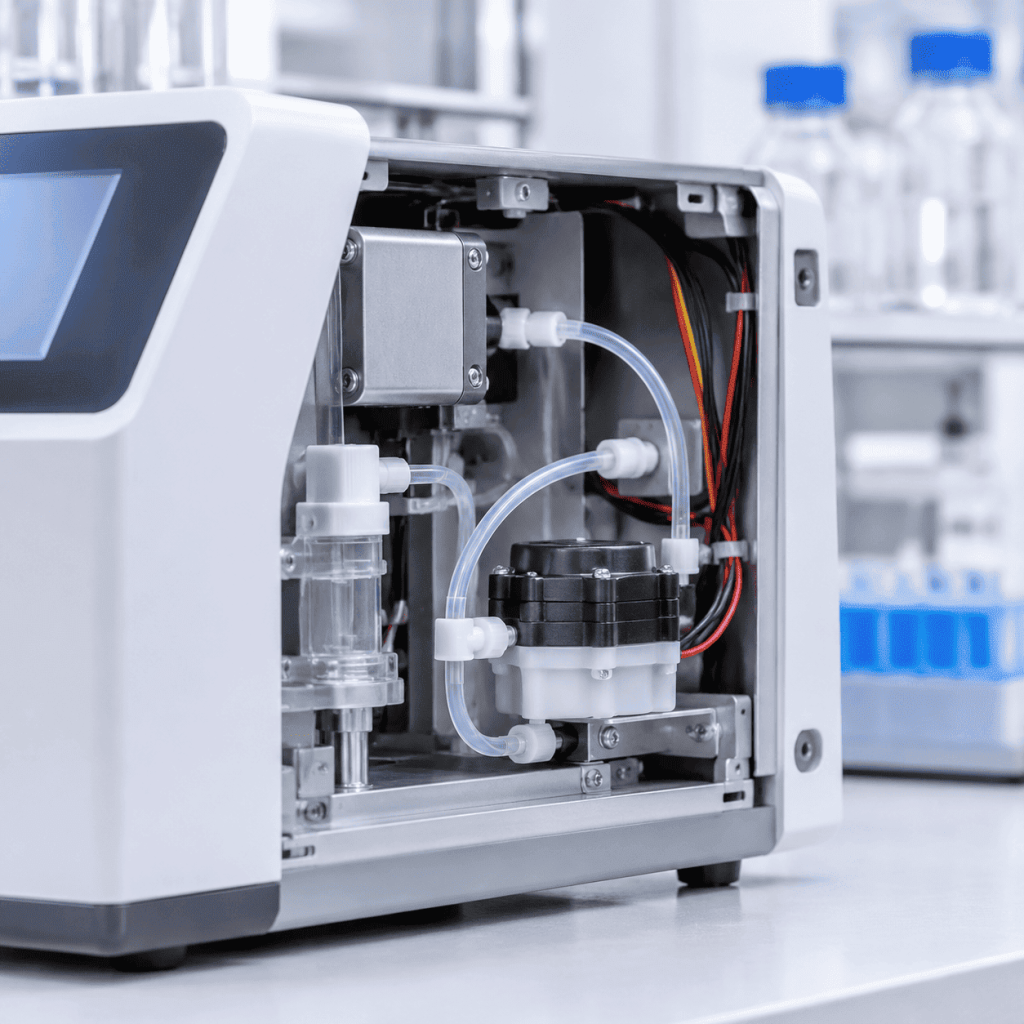
Liquid Transfer and Circulation
Liquid diaphragm pumps can be used in compact equipment that requires controlled liquid transfer or circulation.
Potential applications include:
Medical and care equipment
Laboratory and analytical instruments
Water and liquid sampling systems
Compact liquid circulation equipment
Chemical and industrial equipment, where material compatibility is confirmed
The liquid’s viscosity, chemical properties, temperature and particle content should be considered during pump selection. Wetted materials and valve configurations must be suitable for the actual medium.
Air Supply and Pressure Generation
Gas diaphragm pumps can be used to supply air or other compatible gases in compact equipment.
Depending on the model, applications may include air sampling, pneumatic functions, gas circulation and pressure generation. The required flow rate and outlet pressure should be evaluated together because maximum flow and maximum pressure are not necessarily available at the same operating point.
Vacuum and Suction Applications
Some gas diaphragm pump configurations are designed for vacuum generation or suction applications.
The achievable vacuum level, flow rate under vacuum and operating stability depend on the pump design and system conditions. Not every gas diaphragm pump supports both positive-pressure and vacuum operation.
For applications requiring both functions, confirm that the selected model is specifically designed for the required operating range.
Medical, Laboratory and Industrial Equipment
Compact diaphragm pumps are used in various types of equipment where liquid or gas handling is required.
Examples include laboratory analytical instruments, sample preparation systems, medical and care equipment, gas detection devices and industrial control equipment.
The required pump configuration depends on the function of the equipment. For example, a liquid-handling instrument may require a liquid diaphragm pump, while an air sampling or suction system may require a gas diaphragm pump.
5. How to Select a Brushless DC Micro Diaphragm Pump
Selecting a suitable pump requires a clear understanding of the application and operating conditions. The following factors can help OEM engineers narrow down the options.
Liquid or Gas Configuration
First, identify whether the pump needs to handle liquid or gas.
Liquid and gas configurations may use the same basic diaphragm pumping principle, but their materials, valves and performance characteristics can differ. The selected pump must be designed for the intended medium.
Flow Rate, Pressure and Vacuum
Define the required flow rate and operating pressure or vacuum level.
For liquid applications, consider the required flow rate at the actual system pressure. For gas applications, specify the required flow and whether the pump needs to generate positive pressure, vacuum or both.
Avoid selecting a pump based only on its maximum flow rate or maximum pressure. These values may represent different operating conditions.
Voltage and Motor Control
Confirm the available power supply, such as the required DC voltage, and whether the pump needs fixed-speed or variable-speed operation.
If external speed control is required, provide details of the preferred control signal or interface. The motor and controller must be compatible with the equipment’s electrical system.
Fluid Compatibility and Operating Conditions
For liquid applications, provide information about the medium, including:
Chemical composition and concentration
Viscosity
Operating temperature
Whether the liquid contains particles
Required wetted materials
For gas applications, identify the gas composition, temperature and any special operating requirements.
Material compatibility should be assessed for the actual medium and operating conditions rather than assumed from the general pump type.
Installation Dimensions and Connections
Check the available installation space, mounting position, inlet and outlet connection sizes, tubing requirements and electrical connections.
For OEM integration, it is also useful to consider noise and vibration requirements, maintenance access and the position of the pump within the overall fluid or gas circuit.
6. OEM Integration and Customization Considerations
Choosing a pump for OEM equipment is a system-level task. The pump must work with the equipment’s mechanical structure, electrical design and fluid or gas circuit.
Depending on the selected model and project requirements, OEM discussions may cover:
Flow rate, pressure or vacuum requirements
DC voltage and motor configuration
Pump dimensions and mounting arrangement
Inlet and outlet connections
Wetted materials
Wiring and connector requirements
Operating cycle and expected service conditions
Not every specification can be changed on every model. Customization options should be evaluated according to the existing pump platform, technical feasibility and project requirements.
If the final operating conditions are not fully defined, OEM customers can start by sharing the equipment application, a description of the pumping function, available installation space and any known performance targets. A pump manufacturer can then help assess suitable configurations.
For more information, see our guide on what information is needed for a custom micro pump quote.
7. Why Choose JIGU Brushless Micro Diaphragm Pumps?
JIGU manufactures micro diaphragm pumps for OEM equipment manufacturers and fluid-handling applications.
Brushless DC motor configurations are a main option in our micro diaphragm pump range. Brushed DC configurations can also be considered where appropriate.
Our micro diaphragm pump solutions cover liquid and gas applications. Depending on the selected model, gas pump configurations may support positive-pressure supply or vacuum suction.
For OEM projects, JIGU can evaluate pump configurations according to the required flow rate, pressure or vacuum, voltage, medium, installation dimensions and connection requirements.
If you are developing new equipment or looking for an alternative pump supplier, you can review our micro diaphragm pump solutions or contact our team to discuss your application.
You may also find these guides useful:
Micro Diaphragm Pump Applications: Liquid, Air and Vacuum
How to Select a Micro Diaphragm Pump for OEM Equipment
8. Frequently Asked Questions
What Is the Difference Between Brushless and Brushed Diaphragm Pumps?
The main difference is the motor structure. A brushed DC motor uses mechanical brushes and a commutator, while a brushless DC motor uses electronic commutation. The diaphragm pumping principle can be similar in both types.
Can a Brushless Diaphragm Pump Be Used for Both Air and Liquid?
Diaphragm pumps can be designed for either liquid or gas handling. However, a particular model should only be used with the medium and configuration for which it is designed. Liquid and gas versions may differ in materials, valves and performance.
Can the Speed of a Brushless Diaphragm Pump Be Adjusted?
Some brushless diaphragm pump configurations support speed adjustment through a compatible electronic controller or control interface. This capability depends on the motor, drive and pump model, so it should be confirmed before selection.
Are Brushless Diaphragm Pumps Suitable for Continuous Operation?
They can be suitable for extended or frequent operation when the pump is designed and selected for the required duty cycle. The diaphragm, valves, motor, controller, temperature and medium must all be considered. Confirm the operating conditions with the manufacturer.
Can JIGU Customize Diaphragm Pumps for OEM Equipment?
JIGU can evaluate OEM requirements such as flow rate, pressure or vacuum, voltage, materials, dimensions and connections. Available customization options depend on the selected model and technical feasibility. Customers can share their application details to begin the evaluation.
Need a Brushless Micro Diaphragm Pump for Your Equipment?
If you are developing equipment that requires compact liquid transfer, air supply or vacuum generation, JIGU can help evaluate a suitable micro diaphragm pump configuration.
Share your application, required performance, power supply and installation requirements with our team.
Contact JIGU to discuss your OEM micro diaphragm pump project.
Related Products
Reach Out Today
Looking for a micro pump manufacturer for your project? Contact JIGU Pump to discuss your application requirements and get a suitable pump recommendation and quotation.

Share Your Requirements
Share your application requirements, technical specifications, drawings, or reference images with our team.

Receive a Solution & Quotation
Our team will review your requirements and provide a suitable pump recommendation and quotation.

Confirm & Start Production
After sample approval and order confirmation, we proceed with production and arrange shipment according to the agreed schedule.